How to Style a Living Room Around One Statement Piece
A single confident object can organise an entire room. Here is how to choose it, place it and support it.
The most memorable living rooms rarely rely on a long list of features. They usually have a single idea that everything else respects: a sculptural sofa, a large piece of art, a carved stone table. Designing around one statement piece makes decisions easier and the finished room calmer.
Start with the anchor
Choose the piece first and the room second. It should be something you would still enjoy looking at in ten years: well proportioned, made from honest materials and large enough to hold its own. Common anchors include a curved sofa, a travertine coffee table, an oversized abstract painting or a vintage cabinet.
Give it space
A statement piece needs breathing room. As a rule of thumb, leave at least 60 centimetres of clear floor or wall around it, so the eye can read its outline. Crowding it with side tables and accessories weakens the effect.
Test the scale before you commit
Before buying, mark the footprint of the piece on the floor with masking tape, or tape sheets of paper to the wall in the size of the artwork you have in mind. Leave the outline in place for a day or two. Walk around it, sit near it and check that doors, drawers and walkways still work. This simple test catches most problems of scale before they become costly ones, and it often shows that a slightly larger piece would look more confident.
Build a quiet supporting cast
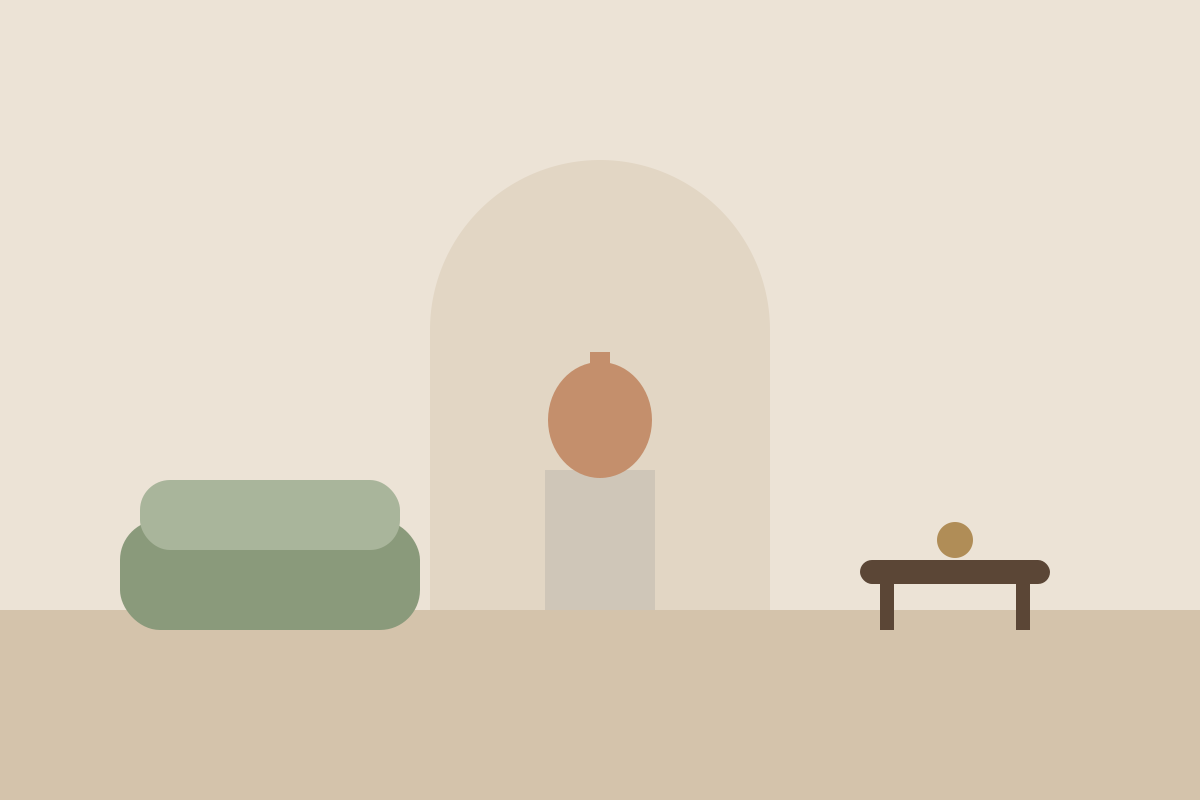
Everything else should step back. Choose supporting furniture with simple lines and a restrained palette, and repeat one colour or material from the anchor piece somewhere else in the room. If the anchor is warm travertine, a cream wool rug and a single honey-toned wooden stool will echo it without competing.
- Keep to two or three main colours.
- Mix at most three materials in the supporting pieces.
- Use one or two accessories per surface rather than many small ones.
Light it deliberately
Lighting is what makes an anchor piece feel intentional. A wall washer, a floor lamp angled toward the object or a picture light can give it presence in the evening, when most living rooms are actually used.
Common mistakes to avoid
- Introducing two or three statement pieces that compete for attention in the same room.
- Choosing an anchor that is too small for the space, so it reads as an accident rather than a decision.
- Matching every other item to it exactly, which flattens the room instead of supporting it.
- Pushing a piece designed to be seen from all sides hard against a wall.
- Surrounding it with trend-led accessories that will date long before the piece itself.
Working with a modest budget
A statement piece does not have to be new or expensive. Vintage shops, auctions and second-hand marketplaces are good sources of solid, well-made furniture with real character. A large canvas painted in two or three calm tones can hold a wall as well as a purchased artwork, and an older cabinet can be transformed with careful cleaning and new handles. If you are buying new, it usually makes more sense to spend on the anchor and keep the supporting pieces simple than to spread the budget evenly across the room.
Edit before you add
When the anchor is in place, live with the room for a few weeks before adding anything. Many rooms feel finished sooner than expected, and the best decorating decision is often to stop.